OM NAMAH
OM NAMAH
OM NAMAH
Info
Info
Info
Role: Product Designer
Role: Product Designer
Role: Product Designer
Timeline: 12 months
Timeline: 12 months
Timeline: 12 months
Platform: Android and ios
Overview
Overview
Overview
OmNamah is a Hindu lifestyle platform designed for the global NRI community, bringing traditionally
fragmented experiences into one mobile ecosystem.
The product brings together daily Panchang, temple discovery, live Darshan, regional communities,
astrology, devotional content, festival reminders, Muhurat, Japam tracking and Vastu guidance.
The Problem
The Problem
The Problem
The Problem wasn't missing content. It was scattered content with no trusted home.
Fragmentation: participants used an average of 3-4 tools to handle routine practice.
Timezone math: Panchang and Muhurat are calculated for Indian locations. Users
converted times by hand and often got them wrong.
Trust: users couldn't verify whether a priest or an online puja was authentic.
Language: elders in the household preferred [Telugu/Tamil/Hindi…], while younger
members preferred English.
How might we make daily spiritual practice feel as effortless abroad as it does at home, without flattening the depth of the tradition?
Product Research
Product Research
Product Research
I talked to NRI users across USA to learn how practice happens, not just what people say they want.
I talked to NRI users across USA to learn how practice happens, not just what people say they want.
I talked to NRI users across USA to learn how practice happens, not just what people say they want.
Method
Method
Method
Who
Who
Who
What it answered
What it answered
What it answered
1:1 interviews
1:1 interviews
1:1 interviews
NRIs aged 32- 65 in USA
NRIs aged 32- 65 in USA
NRIs aged 32- 65 in USA
Daily and festival routines, current tools and pain points
Daily and festival routines, current tools and pain points
Daily and festival routines, current tools and pain points
Survey
Survey
Survey
Community groups / temples
Community groups / temples
Community groups / temples
Frequency of use
Frequency of use
Frequency of use
Competitive audit (1 app)
Competitive audit (1 app)
Competitive audit (1 app)
Moksha Nidhi
Moksha Nidhi
Moksha Nidhi
Gaps in trust, language and breadth
Gaps in trust, language and breadth
Gaps in trust, language and breadth
Spiritual and cultural activities are highly contextual.
Users may need to answer very different questions throughout the day:
What is today's Panchang?
Which temple is nearby?
When is the right Muhurat?
What festival is coming up?
How do I perform a particular practice?
Where can I watch a live Darshan?
How can I maintain a daily Japam practice?
The challenge wasn't simply adding features. It was creating a coherent product architecture that could make a broad set of culturally specific experiences feel discoverable, trustworthy, and simple to use.
Product Opportunity
Product Opportunity
Product Opportunity
Move users from searching across multiple sources and services to completing culturally meaningful tasks within one trusted experience.
Move users from searching across multiple sources and services to completing culturally meaningful tasks within one trusted experience.
Move users from searching across multiple sources and services to completing culturally meaningful tasks within one trusted experience.
Home screen

Find nearby

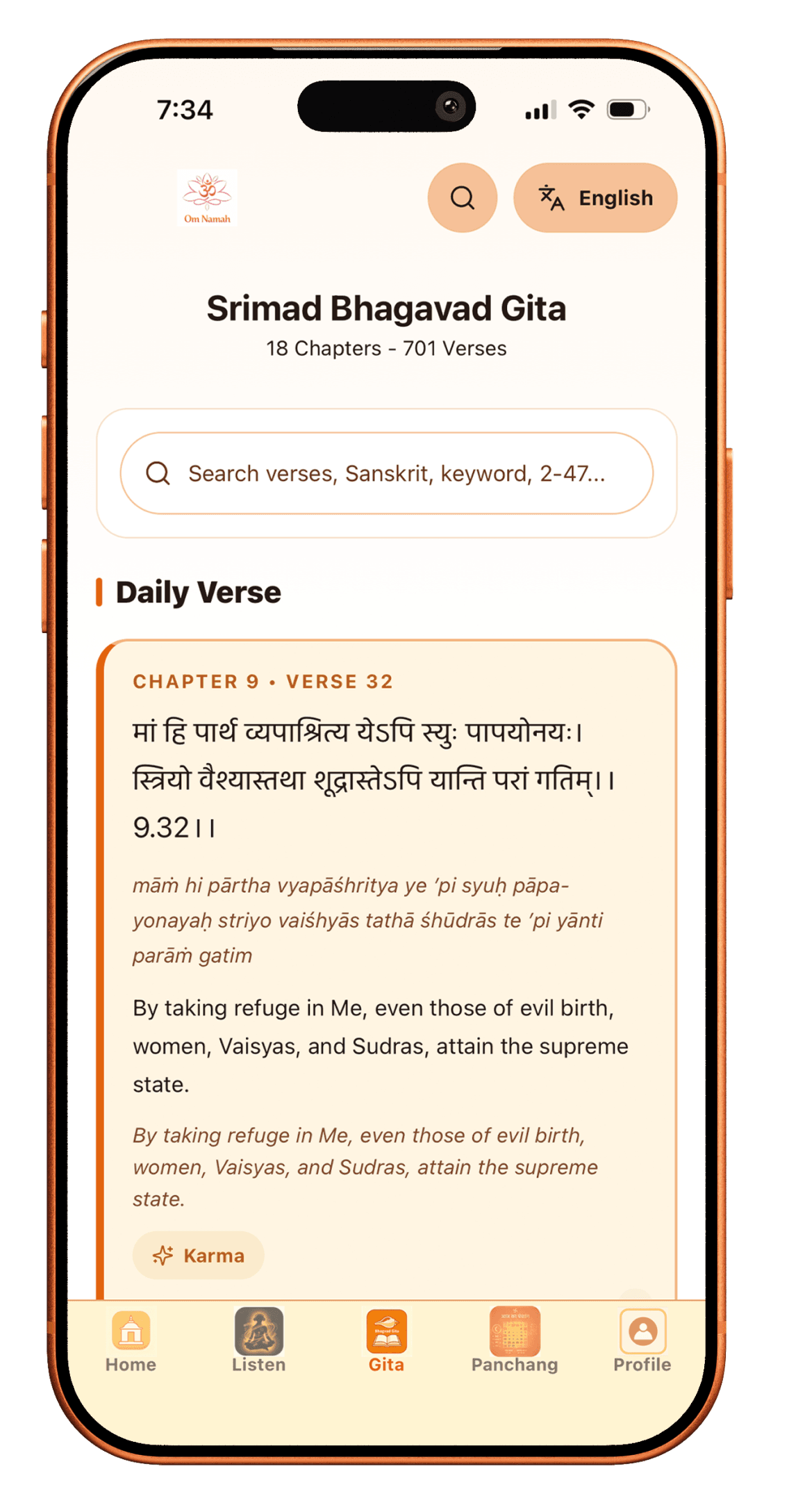
Bhagavad Gita
Information Architecture
Information Architecture
Information Architecture
"Don't hide complexity. Organize it."
Card sort results showed users grouped features by intent, not by content type.
I grouped content around what people were trying to accomplish:
Practice: Daily Sadhana, Japam Counter, Meditation, and devotional audio
Learn: Bhagavad Gita, Shlokam, spiritual insights, and VedicHub
Plan: Panchang, Muhurthams, Yearly Calendars, and Festivals
Connect: Nearby temples, priests, cultural organizations, and Live Darshan
Personalize: language, location, regional calendar, reminders, saved content, and goals
This model helped connect related experiences without hiding culturally specific terminology. Labels such as Panchangam, Muhurthams, and Japam remained recognizable to the intended audience, while supporting descriptions explained what each destination offered.
The final structure combines:
5 persistent navigation destinations
A personalized Home dashboard
11 Quick Actions
Focused tools for complex activities
Shared search and language controls
Cross-links between related spiritual, calendar, audio, and practice experiences
The result is an architecture that allows Om Namah to support a wide range of spiritual needs while giving users stable starting points for daily use.

Product Thinking
Product Thinking
Product Thinking
One of the biggest design challenges was balancing:
Breadth vs. simplicity
OmNamah has a large feature ecosystem. More functionality creates more value—but also increases
cognitive load.
My design approach was therefore:
Don't hide complexity. Organize it.
Rather than reducing functionality, I focused on creating hierarchy, grouping related experiences, and establishing clearer paths to high-value actions.
One of the biggest design challenges was balancing:
Breadth vs. simplicity
OmNamah has a large feature ecosystem. More functionality creates more value—but also increases cognitive load.
My design approach was therefore:
Don't hide complexity. Organize it.
Rather than reducing functionality, I focused on creating hierarchy, grouping related experiences, and establishing clearer paths to high-value actions.


Key takeaway
Key takeaway
Key takeaway
OmNamah taught me that good product design isn't about simplifying the product by removing complexity—it is about making complexity feel understandable.
I designed the experience around the way people actually discover, practice, and participate in their culture, while creating a scalable foundation for personalization, AI-assisted experiences, and future community growth.
Thanks for
Stopping by.
Thanks for
Stopping by.
Thanks for
Stopping by.
Revanth Kadaboina
Revanth Kadaboina
UX / Product Designer
UX / Product Designer